Quick answer
You must declare all food and agricultural items when you enter the United States. This includes meat, fruit, vegetables, plants, seeds, soil, and animal or plant products, including soups. If you do not declare prohibited items, they are seized and you can be fined up to $1,000 for a first offense.
Checked on November 13, 2026 against U.S. Customs and Border Protection: Bringing Agricultural Products Into the United States.
| Situation | What happens |
|---|---|
| You declare an item and it passes inspection | You keep the item |
| You declare a prohibited or restricted item, non-commercial quantity | You can abandon it and continue your trip |
| You do not declare a prohibited item, non-commercial quantity | The item is seized; fine of up to $1,000 for a first offense |
| Items are for commercial use | Violations are penalized at a much higher rate |
| Item is seized or abandoned | Destroyed at the port of entry using USDA-approved methods |
These rules apply to every traveler. It does not matter whether you travel with an ESTA or a visa. If you are not sure which one you need, see ESTA or visa: which one do you need for the US?
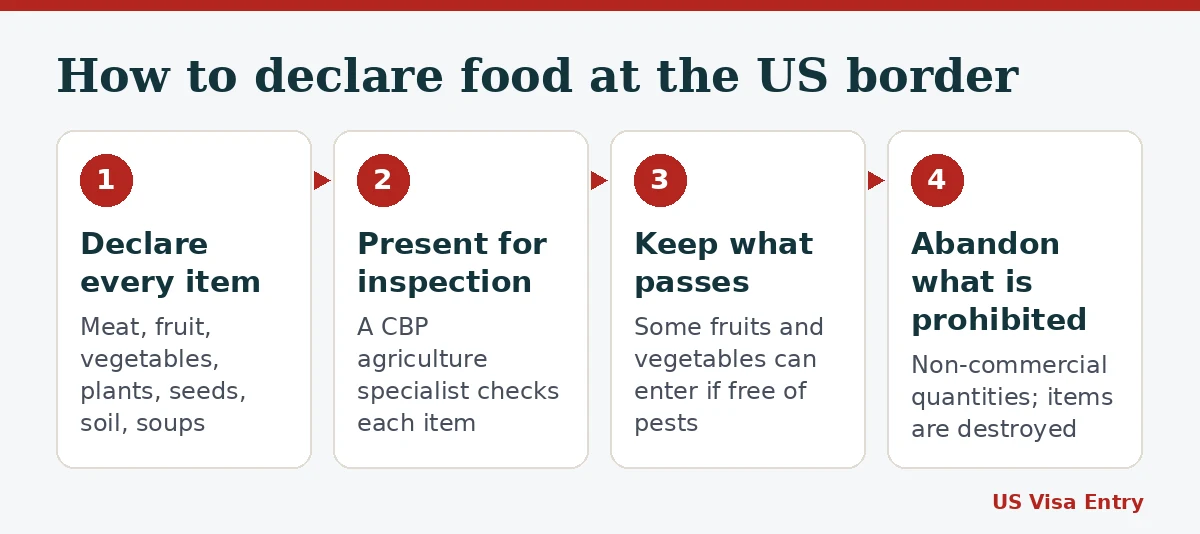
How to declare food: step by step
- Declare every item. Tell CBP about all meat, fruit, vegetables, plants, seeds, soil and animal or plant products you carry. Include items in checked bags, carry-on bags and your vehicle.
- Present the items for inspection. A CBP agriculture specialist decides whether each item can enter. Do this even if you think the item is allowed. The rules change often, and you are responsible for declaring.
- Keep the items that pass. Some fruits and vegetables can enter without an advance permit if they are declared, inspected and found free of pests.
- Abandon what is not allowed. If a declared item is prohibited or restricted and is in a non-commercial quantity, you can abandon it at the port of entry and continue into the United States.
For the rest of the arrival process, see Arriving in the United States: border control and the I-94. For more entry topics, browse our guides or read ESTA questions and answers.
FAQ
Can I bring fruit and vegetables into the United States?
Most fruits and vegetables are not allowed in personal baggage without a permit. Some can enter without an advance permit if you declare them, they are inspected, and they are found free of pests.
Can I bring products that contain meat?
Meat from restricted countries is usually prohibited, even as an ingredient in another product. Beef broth is one example CBP gives. Declare any product that contains meat.
Do I need to declare food in my carry-on bag?
Yes. The declaration covers items in checked baggage, carry-on bags and vehicles.
Can I bring soil or sand?
No soil is allowed without an advance permit from the USDA permit unit. Clean sand is usually allowed.
Do I also need to declare cash?
Yes, if you carry currency or monetary instruments over $10,000 in total. You must report it on the CBP Form 6059B customs declaration and file FinCEN Form 105.
Sources
- U.S. Customs and Border Protection: Bringing Agricultural Products Into the United States
- U.S. Customs and Border Protection: Applying for Admission into the United States
This guide is general information, not legal or immigration advice. US Visa Entry is an independent website and is not connected with the US government.